Learn How to Sell on eBay with Lynn Dralle
Meet Lynn, The Queen of Auctions for Over 40 Years
My name is Lynn Dralle and I am here to teach you
how to sell on eBay.
For over 18 years, I have made my living buying and selling on eBay. I am a third-generation antiques dealer with over 40 years experience in the antiques business (I started helping my grandmother in the antiques store and at shows when I was just 5). I am also an eBay consultant, author, and teacher.
My products and tools will teach you how to sell online with eBay while staying organized, turning a profit, and having fun!
I love selling on eBay and can't stop-- some people think I am addicted! In 2012, I sold $101,900 worth of unique items on eBay and I want to help you do the same by teaching you how to sell on eBay.
I've made my living buying and selling unique one-of-a-kind items on eBay and you can sell online, too. Selling on eBay is an enjoyable experience that anyone can learn when you have the right teacher. I will show you which items to buy, how to sell on eBay, and so much more.
Please sign up for my free newsletter that is filled with fun tips and tricks.

Cash for COFFEE MUGS (eBook)
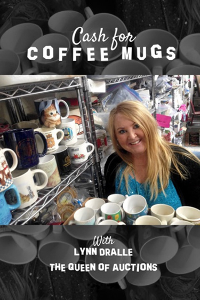
Lynn's latest eBook is called Cash for Coffee Mugs. Over a year in the making and 435 pages later, this eBook will teach you how to generate Cash for your Coffee Mugs. Loaded with advice, tips and Lynn's 18-years of experience successfully buying and selling on eBay, this eBook will be sure to take your eBaying to new heights.
What Readers Are Saying
"Lynn, I think you outdid yourself on the Coffee Mug eBook. So very interesting. I could not stop reading! Thank you!"
"Hi Lynn--I was very excited to get your Cash for Coffee Mugs. It certainly didn't disappoint. It is very informative and entertaining. I will definitely be listing more Coffee Mugs on eBay in the future. Thank you for your informative book. I have read several of your books and you have definitely been an inspiration to me in selling on eBay. Keep up the good work.
Jean Mackey"
"Hi Lynn, I enjoy reading about you, the family and the many ways to be successful on eBay. We sell in different arenas but I find some of your methods can be applied to my area. Many thanks for all of your suggestions and comments in the Coffee Mug eBook!
Sincerely, William"

How to Sell On eBay
Top how-to product recommendations to learn at your own pace
 BEGINNER
Six Steps to eBay Success
Learn how to sell on eBay with this six step downloadable course will walk you through the entire selling process from finding items, to listing them, to collecting money and finally shipping them. With actual lessons, homework and tasks to perform you will soon be on your way to eBay success. This step-by-step how-to e-course is perfect for the beginning to intermediate seller.
More Information or Buy Now >>
INTERMEDIATE
Dinnerware Success : Selling Dinnerware on eBay
Join the crowd of people who have discovered that selling dinnerware on eBay is a great profit center for their business. My new Dinnerware Success eBook will show you how you can add this profitable category to your eBay sales. This is an eBook available for instant download.
More Information or Buy Now >>
 PRO
PRO
A Weekend at Lynn’s
Our newest and highest tier program is officially launched. We are calling it "A Weekend at Lynn’s." This is your chance to get personalized individual attention to help you change your life and your eBay business. Since it is a new product, it can bend and change to meet your needs. Lynn will design a special weekend for you tailored to what you need to focus on in your eBay business.
More Information or Buy Now >>
Become a Queen's Court Member
Read what Queen's Court Members & eBay students have to say:
"I have purchased several of Lynn's eBay
books and her online "Six Steps to eBay Success with
eBay." It has definitely increased my sales. She has been
an inspiration to me ..." - Genia 3/14/2009
"Her streamlined method, sincere, caring, positive attitude
and Queen's Court, e-zines, teleseminars, and DVD's have helped
me to get to where I am and give me hope for a bright future."
- Jude 3/10/2009
"I had received my Dinnerware eBook a couple of weeks ago. My husband and I went to an estate sale the very end of January. My husband was freaking out because I was spending $100 for a set of stoneware. I told him I was going to put them on E-Bay and he just said, "I hope you get your $100 back." I DID! One sale at auction added up to $386.39. Then I also sold a teapot for $53.00 and 3 salad plates @ $14.99 each. Grand total so far is $484.36 and I still have a lot of pieces left. WOW! I just wanted to thank you so much for all your help. This certainly paid for my eBook and way more. Thanks a bunch!!" - Linda Bostock